Posts

Future Beyond AI: Shifting focus form Artificial Intelligence (AI) to Human Augmentation (HA) via HSDD Technologies

Artificial Intelligence (AI) is gaining significant interest and hype across the globe.  AI can be used for automation, content generation, conversation, decision-making and recommendations, and seems to promise several befits such as efficiency and productivity. Benefits are there, however, there are also increasing concerns about AI safety, ethics and its adverse impacts e.g. replacing people and their jobs.   In this post, I will not boast about the AI and its related concepts such as Agentic AI and so on. I will focus  on the future and a shift from AI to HA (Human Augmentation)  for the greater good of people, peace and prosperity (e.g. value for countries, customers, businesses, staff and society).  so let's  begin with defining the concepts of HA or human augmentation? Human Augmentation (HA) Humans have the physical structure, sensors, motor skills and cognitive ability to think, store, communicate and perform actions for achieving mental and p...

Scalable Enterprise AI: Thinking, Architecting and Building (TAB) Intelligent Software Systems

Image
  Intelligent Software System Artificial intelligence (AI) systems seem to replicate or mimic or augment  human capabilities. There is an increasing interest in adopting such intelligent software systems for automation, decision-making, and recommendations etc.  The Challenge Isolated or individual AI applications, models, proof-of-concepts (PoCs) and protype developments often fail to integrate with or scale at the enterprise level as production ready enterprise systems. This draws our attention to the following key questions:   How would applications and models share data with each other?  How can we ensure that the models have controlled access to the right data based on their permission or need to know basis?  How can we avoid vendor lock-in where enterprises depend on different agents developed or provided by different service providers across the heterogeneous multi-cloud and on premises computing environment?  How can we ensure communicatio...

AI-enabled Intelligent Enterprise: AI Co-pilots

Image
AI-enabled Intelligent Enterprise  There is an increasing interest in Artificial Intelligence (AI)  systems for decision making, productivity gain, better quality products and services etc. There is a fear or assumption that AI systems will replace human. We should not assume that AI systems will replace humans, rather we can look at them as our agent or  assistants.  Human is the "Principal" who delegates the tasks to the AI system that is called an "Agent". Thus, there is a principal-agent relationship (delegation) between the human and AI system.   AI Co-pilot There are several facets of AI systems, in particular the AI co-pilot system that can assist humans for carrying out tasks on their behalf. These AI co-pilots can be embedded across the enterprise value chain. This article discusses the AI-enabled intelligent enterprise and the applicability of AI co-pilots across the connected core value chain of (1) strategy, (2) architecture, (3) development and...

AI System Architecture and Health Assessment

Image
AI System AI system receive inputs (data), process them via data processing applications, which can use AI algorithms for further advanced processing of data or intermediate outputs for generating final outputs for desired outcomes. These outputs could be classifications, clustering, contents, decisions, detections, insights, predictions or recommendations. There are several examples of AI systems such as Autonomous Vehicles, Chatbots,  Digital Assistants, Face Recognition and Voice Recognition etc.    A. AI System Architecture AI system architecture consists of at least three interconnected layers and underpinning components: applications, data and algorithms.   Figure 1 . AI System Architecture 1. Application  AI system has AI enabled or augmented or embedded applications that receive initial inputs such as data and apply data processing programs. Based on the processing needs, it makes the data ready for further advanced processing using AI algorithms. A...

Circular Information Lifecycle Management for Enabling Circular Economy

Image
Circular economy is about recycling, remanufacturing, reusing  products, services and information for continuous value re-co-creation while reducing waste and enhancing positive economic, environmental and social impacts. This requires to re-conceptualize and re-design the economic ecosystems and business models for optimisation and innovation.  Information management is extremally important to provide intelligence & insights for effective decision making  and actions enabling circular economy. This article presents the following circular information lifecycle management for enabling circular economy.  In circular information lifecycle management (CILM), information can be restored and recycled like another product or service in the circular economy.  The CILM is composed of six key stages: discover & collect, classify & secure, prepare & release, access & use, archive & purge, and restore & recycle.  Circular Information Lifecyc...

How to define information or data strategy?

Image
Information or data strategy is a part of the overall corporate or business strategy. Information (including data) is an important strategic business asset. Thus, information assets should be managed and treated in the similar way as we manage other business assets. An actionable information strategy is required to for the effective handling of information across the enterprise, irrespective of their size, for achieving the business goals and reducing risk including compliance to regulatory requirements and standards.   This post provides and discusses a simple and practical template for defining the information strategy as a part of the business or cooperate strategy. Information strategy can be defined at the ecosystem, enterprise, business function, business area or capability level as appropriate to your context and needs. Information strategy has following key 8 elements (Figure 1): Mission & Vision, Levers & Value Driver, Goals & Objective, Strategies & T...

What is Information? A Theory of Information Trilogy

Image
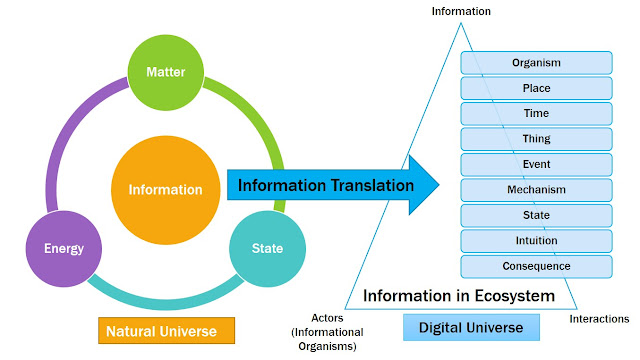
A Theory of Information Trilogy for Information Ecosystem by Asif Gill Information is/of Everything (IioE) We hear many definitions of information and related concepts such as data, information itself, knowledge and intelligence. Well, all these definitions seem useful from information probability, quantification, measurement, storage, processing and management perspective. We still wonder what is "it" and how to identity "it", which we call "information". This blog defines and describes nature ecosystem inspired definition of information, which is called here a "Theory of Information Trilogy" (ToIT).  This theory is defined with a view to define and identify information in complex and heterogenous information ecosystems.  This theory defines that the information is (1) matter and (2) energy, which has different (3) states or forms. Matter and energy flow in the natural ecosystem. Further, from natural ecosystem, these 3 matter, energy and their ...

Integrating Agile Planning and Estimation into Traditional Methods for Large Projects

Image
Agile processes are often considered challenging to adopt in larger and formal project development and management environments. It may not be possible and need for an organisation to adopt a pure agile process for a large project. How can organizations adopt agile planning and estimation best practices within their formal and generic process lifecycle (GPL)? This article presents an agile planning and estimation model that can be used for large projects as a guide. Agile Process The core of the agile process is a collection of sprints or small increments. The agile process can be classified into three key categories or stages: ·        Pre-Sprint – focus on the analysis activities of the GPL ·        Sprint – focus on the planning and development activities of the GPL ·        Post-Sprint – focus on the sprint post-mortem and release activities of the GPL.   The agile process has ...

Adaptive Enterprise Architecture for Digital Innovation and Transformation

Image
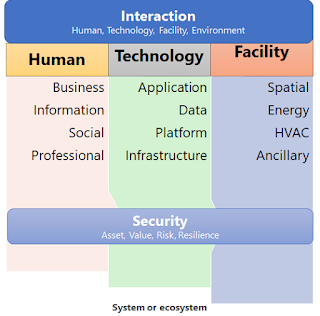
Enterprise Architecture (EA) could be considered a descriptive and/or prescriptive design of an enterprise. Traditional approaches to EA heavily  focus on the modelling and documentation aspects and tend to overlook the actual stakeholders and their needs, in particular, when dealing with complex and large digital innovation and transformation. This calls  for the need of an adaptive EA. Based on ISO/IEC/IEEE 42010:2011, an adaptive EA is the fundamental concepts or properties of an adaptive enterprise service system or ecosystem: situated in its environment (e.g. political, economic, sociological, technological, legal and environmental),  embodied in its elements (e.g. interaction, human, technology, facility),  relationships (e.g. type and strength) to each other and its environment, and  in the adaptive principles of its secure design and evolution. The Gill Framework ® V4.0 Adaptive EA requires a fundamental shift the way currently organ...

Adaptive Design Principles

Designing an adaptive enterprise or business requires fundamental design principles. This post discusses the six broad six categories of adaptive design principles (agility, design thinking, model thinking, resiliency, service thinking and systems thinking) as outlined in the adaptive design principles catalog from  The Gill Framework® . These principles can be tailored and applied in a particular context. For instance, these principles can guide the design of the adaptive enterprise capabilities, teams, processes, services, systems etc. Agility ·          Flexibility: built-in flexible response to changes ·          Leanness: built-in quality with optimal or minimal resources ·          Learning: built-in analytics-information for continuous learning ·          Responsiveness: design for (response) change · ...

Adaptive Architecture Storytelling Viewpoint Template

Adaptive or agile architecture design [artifact] and practice [activity of design] involves storytelling. In this post, I would like to share some of my experience from recent projects in the form of a following Architecture Storytelling Viewpoint template. Context : Policies, Principles, Strategies, Environment, Business Model, Operating Model ... 1. [Stakeholders] It starts with subject or area of interest [ Who ]  i.e. Person, Role, Organisation, Department, Division. Here focus is on identifying, understanding, prioritizing, estimating, planing and classifying the [Who] stakeholders (the most important part of the architecture) with certain area of interest (e.g. Marketing, Sales, People and Culture, Finance). You can design stakeholders map and empathy map to elicit "Who" for a certain area of interest . This is really about stakeholders or customer-centric architecture as opposed to an IT centric architecture. AS a Stakeholder..... 2. [Concerns] This ...

Leading Success: Reflections and Learnings

Leadership is hard and success is even harder. It depends how you define leadership and success for your personal context? Over a period of last two decades , I worked with and mentored by a number of intelligent people. This post shares my personal reflections and learnings  so far in 5 principles, which are part of my persona and still evolving. Personalisation  Persuasiveness  Patience  Persistence Progressive Personalisation  Personal respect, recognition and  individualisation of interactions or dealings or transactions rather being rude or vague or too generic. Persuasiveness Being able to influence through reasoning and demonstration rather imposing or enforcing decisions. Patience Being able to tolerate, listen and facilitate rather being harsh and unhelpful while others are catching up. Persistence Being able to stay calm, steadfast and steady the ship in response to difficult or challenging situation.Roll the ball everyday. Pr...

Information Economy: Roles

Sharing some thoughts about roles in information economy Information Minister Information Secretory Information Commissioner Information Governor Information Manger Information Strategist Information Economist Information Architect  Information Analyst Information Engineer Information Administrator Information Auditor Information Broker Information Provider Information Creator Information Consumer Your thoughts?

Adaptive Architect Roles

In my last post, I discussed about the customer-centric value proposition oriented adaptive architecture for enabling business sustainment, optimisation, innovation and transformation. This post further expands on the role of an adaptive architect. An adaptive architect needs to be embedded in the business to understand the stakeholders' concerns and viewpoints from within the internal business and external business operating environment perspectives. An adaptive architect can assume different roles to address different stakeholders' concerns. Analyst and Synthesist Collaborator Co-creator Coach Consultant  Doctor (Business Health Checks & Surgery for Sustainment, Improvement and Transformations ) Innovator  Servant Leader  Thought Leader  Trusted Advisor  Trainer Transition Manager More.... What are your thoughts? Thanks.    

Customer-centric and Actionable Value Proposition Oriented (VPO) Adaptive Enterprise Architecture (EA)

The emerging new digital ways of working, living and trends such Agile, Analytics, Big Data, Blockchain, Cloud, Internet of Things (IoT), Mobile and Social require fundamental shift in design and implementation of enterprise architecture (EA). Traditional documentation-driven EA approach often falls short when a fast collaborative response is required to deal with the always changing demands of customers. It is not only about APIs, service orientation or micro services etc. We need more customer-centric and actionable value proposition oriented (VPO) adaptive EA approaches. How to harvest an adaptive EA practice? Here are some important points to start with from your customer perspective. 1) Who are you? Look at EA practice and role from customer perspective.     2) What do you do? Look at your service offerings from customer perspective. 3) Why does it matter? Look at the value propositi...

Analytics-enabled Resilient Digital-Physical Ecosystems: Industry, Government and Community

Resilience is the ability to proactively monitor, analyse, predict and act to effectively defend (protection), respond (sustainment) and evolve (adaptation) in response to expected and unexpected disruptions. Being resilient is challenging for industry, government and community living or operating in a highly dynamic environment. Lack of an effective resilience capability or practice would lead to frequent undesirable situations or service disruptions resulting in poor service quality and customer or citizen satisfaction, and may potentially cause regulatory, wellbeing or financial implications. There are a number of factors that need to be actively monitored and analysed for effective analytics-enabled resilient digital-physical ecosystem.   These factors could include and are not limited to: Environmental Financial Infrastructure Wellbeing Political Regulatory Social Technological Our recent work on “ adaptive enterprise resilience management ” has be...